

The idea of the Indigenous art collection stemmed from initial conversations around the design of the building and the importance of incorporating Indigenous perspectives and acknowledgement of the extraordinary and ancient landscapes of Darkinung country.
The call went out to local artists to have ‘first dibs’ in providing the contemporary artwork throughout the public spaces of the building, including well-known Coast residents such as Gavi Duncan, Gary Purchase and Wendy Pawley.
Muralist, Brontë Naylor and her team collaborated with Aunty Donella Waters and Dylan Finney to recreate ‘Sea Eagle Over Darkinung’ on a huge scale. The eagle, representing both hope and the future, is 20 metres high and soars across the exterior of the building. It is visible from Rumbalara to the Gosford Railway Station.
The design that sits behind it is an element from one of Donella’s images found inside the building, ‘Inspired by Dilly Bags’ painted in honour of the love and care that her grandmother bestowed on her Kamilaroi grandchildren as they grew up on the Toomelah mission in northwestern NSW.

‘She loved fishing and would take us grandchildren with her clutching her dilly bag as we walked all the way to the river,’ Donella says. ‘Even though the bag was old and well used, to ensure nothing dropped out she would wrap everything very neatly into a small tablecloth and tie a knot with the four corners and put it into the dilly bag. We never got to see her packing all her goodies into the tablecloth, but one thing was for sure, there were always little treats for us kids in that dilly bag.’
In the spirit of collaboration and community, local brothers Grant and Russ Molony created work that responded specifically to the same brief given to the building’s designers, to focus on the characteristics of the natural environment and the distinctive plants and wildlife that define the Coast. In their diptych, ‘Above and Below’, the artists have interwoven the connection of sky, land and sea, hoping to inspire ‘a moment of reflection and appreciation upon the sheer beauty of nature at our doorstep and in the process bring the natural world into the built environment.’
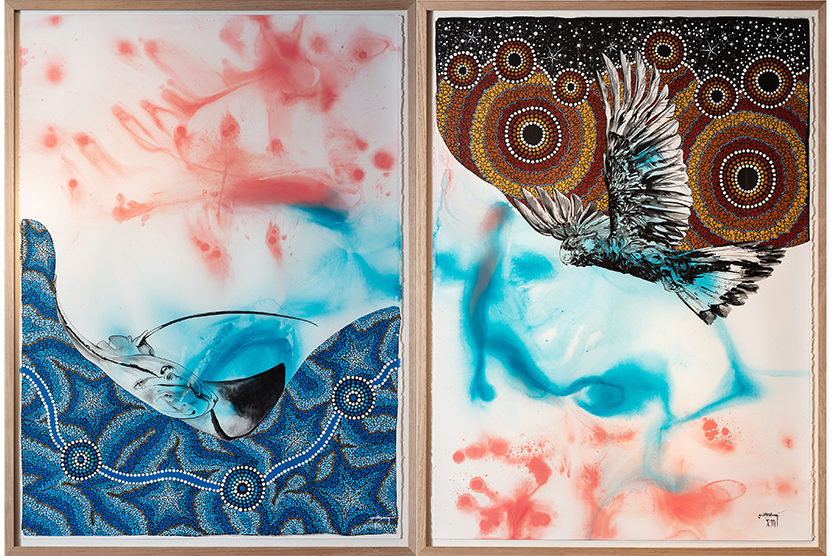
Grant Molony and Russell Molony. Above and Below 2021 acrylic, aerosol and ink on 100% cotton watercolour paper 75 x 105 cm each. Image courtesy the artists.
Once the local artwork was sourced, the hunt was on for work that spoke to the huge variety of contemporary First Nations’ art from art centres in the APY Lands of South Australia, the town camps of Alice Springs, Western Australia, Arnhem Land and the Tiwi and Torres Strait Islands.
In the collection, a beautiful suite of works represents the Warmun community on Gija country in the East Kimberly region of Western Australia. It was here that the famous artist, Rover Thomas, the first Aboriginal artist to be exhibited at the Venice Biennale, lived on the Canning Stock Route. His influence is still seen today, particularly in the use of the harvested ochres that are used as pigment. The works of two of the senior artists from this community, Charlene Carrington and Mabel Juli, are the first that visitors see in the foyer alongside the Acknowledgement of Country.
Exquisitely detailed barks from Yirrkala in North-East Arnhem land are featured on level 10 of the building, with works from the last exhibition by the revered Ms M Wirrpanda. The community gave their approval for release of these barks in the knowledge that they would be on exhibition in this building and able to be viewed by the public, rather than disappearing into a private collection.
The idea of natural materials that provide warmth, familiarity and are grounded in nature, was also considered by artist and designer, Joel Grogan, a Kuku-Jelandji man from Cairns. He looked at weaving as it has been employed for shelter, and as places for protection and gathering. The simple elements of weft and weave were the idea behind his glazing detail used through the internal spaces of the building and also for the external western face. Joel grew up on Darkinung and Awabakal land and wove the form from local lomandra plants. He then created a hand drawn design that provides privacy for the spaces within, making the spaces warm and beautiful.
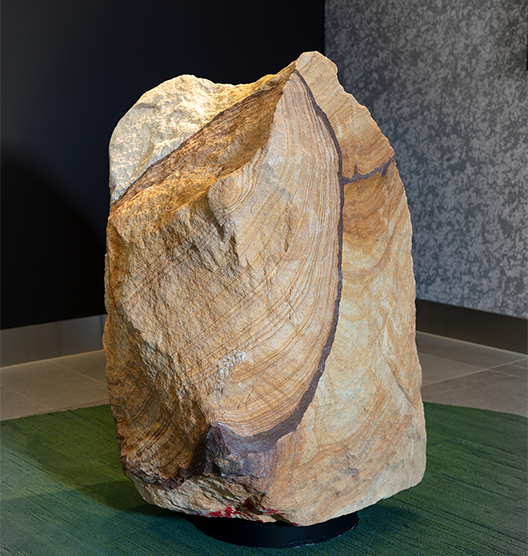
On a very wet day, Darren Nolan, a lecturer from the University of Newcastle’s Thurru Indigenous Health Unit, accompanied by the building’s designer, scrambled over the quarry at Somersby to find the perfect piece of Central Coast sandstone that now sits in place of a yarning circle on level six.
Dylan Finney extensively researched all elements of Brisbane Water and dreamtime stories, and his dreamlike digital mural, ‘Meeting Place’, has also been re-created as part of the exterior courtyard ‘gallery’ space. Dylan’s family hails from northeastern Arnhem Land, but he grew up on the Coast and his incredible work also features on levels 7, 9 and 11 of the building.
Darkinung Elder Aunty Bronwyn Chambers named the building’s spaces in language and also provided sage advice and Indigenous knowledge during the building process. With 72 First Nations artworks and design elements, the Clinical Centre and Research Institute is a very special place to work and visit.
There are several spellings for ‘Darkinjung’ (‘Darkinyung’ for the language), with the author preferring ‘Darkinung’. ‘Kuku-Jelandji’ is also known as Kuku-Yalanji.
WORDS GILLEAN SHAW
GUIDED TOUR OF THE ARTWORKS
Up to 40 COAST magazine readers are invited
on a guided tour of the Indigenous artworks at the
Central Coast Health and Clinical School and Research
Institute in May 2024. If you would like to attend,
please email admin@coastpublising.com.au
Participation is on a ‘first-come, first-served’ basis.