

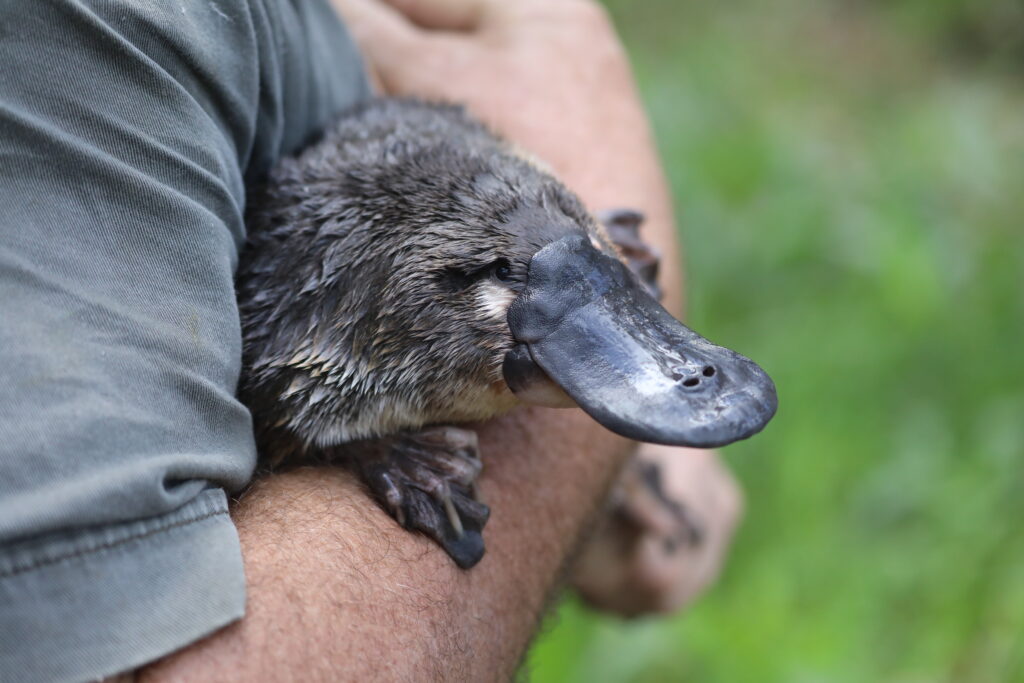
When Europeans first encountered a platypus, the Australian native seemed too bizarre to be true: a mammal that lays eggs, with a beaver’s tail, a duck’s bill and webbed, clawed feet. Later observations also led to the realisation it is venomous, sweats milk and glows in the dark! You’ve got to see it to believe it.
Spotting platypus in the wild is harder than ever. Pollution, land clearing and drought threaten their natural environment. It makes the New South Wales’ animal emblem a little like a canary in a coal mine: their presence – or absence – in creeks and rivers are early indicators of an ecosystem’s health.
In good news for the Central Coast, platypus can be found in the Ourimbah Creek and Wyong Creek catchment areas. But it takes patience and know-how to spot them.
Where to see wild platypus
Billy Collett is the operations manager at Australian Reptile Park. He recommends heading to the upper reaches of Ourimbah and Wyong Creeks, ‘especially in the heavily timbered areas’ because platypus, like their food sources, prefer cooler water. ‘I go out to both those areas quite regularly and I see platypus almost every time I go there.’
Platypus are more likely to linger in areas with steep riverbanks and deeper water. ‘They will go through the shallows, but they really like deep pools because there’s more food in them,’ says Billy.
Best time to spot platypus
Although platypus are nocturnal, there is still some crossover with our day. ‘The best time to see them is late afternoon, just before dark, and first thing in the morning.’
You can increase your spotting chances by waiting for late winter and early spring. This marks increased activity during their breeding season as well as the time of cooler weather that platypus prefer.
Patience will be rewarded. Billy recommends grabbing some binoculars and sitting by a creek edge in the late afternoon without talking. ‘Just sit nice and calm. And be patient.’

What to look for
These naturally shy creatures spend up to 12 hours a day looking underwater for insect larvae, worms and crustaceans to eat.The trick is to sit quietly and wait. ‘Look for ripples coming over the surface. Sometimes there might be a splash and they’ll have a yabby in their bill,’ says Billy.
In breeding season especially, ‘Males zoom along the surface of the water throughout their territory and slap their tails really loud to let other males know they’re there.’
An unlikely encounter
It’s this territorial behaviour that spelled trouble for one particular male. Billy was on his way to work at the Australian Reptile Park when his phone rang. ‘They said there was a platypus in the supermarket loading dock at Lisarow and I thought, no way. It must be a water rat and they’re confused but sure enough, there was a beautiful male platypus.
’After hitting sexual maturity, it’s gone looking for its own territory, crossing a main road and several drains before ending up in the dock. Rescuing a male platypus, though, comes with risk. Males have an inch-long venomous spur on their back legs. While no one has died from a platypus venom, the intense pain reportedly lasts for more than three days. Even morphine is ineffective in numbing the suffering. Moral of the story: look but don’t touch.
Billy took the captured platypus back to the Reptile Park for a vet’s assessment. After the all-clear, he returned it to a spot further up-river, ‘to keep him away from roads and from getting up to mischief at Woolworths.’
Threats
On the Central Coast, platypus habitat is threatened by impacts from household and industrial pollution, and cattle causing erosion around riverbanks. Introduced aquatic weeds have previously choked up Upper Wyong Creek. One of the biggest problems, too, is illegal yabby traps.
‘Platypus go into the traps and then drown because they can’t come up for air,’ says Billy who has found – and destroyed – yabby traps in both Wyong and Ourimbah Creeks.
Guaranteed sighting
If you have no luck spotting platypus in their natural environment, the Australian Reptile Park at Somersby has two female platypuses. One came to the park five years ago after another local rescue. She had a damaged tail and was deemed ‘unreleasable’.