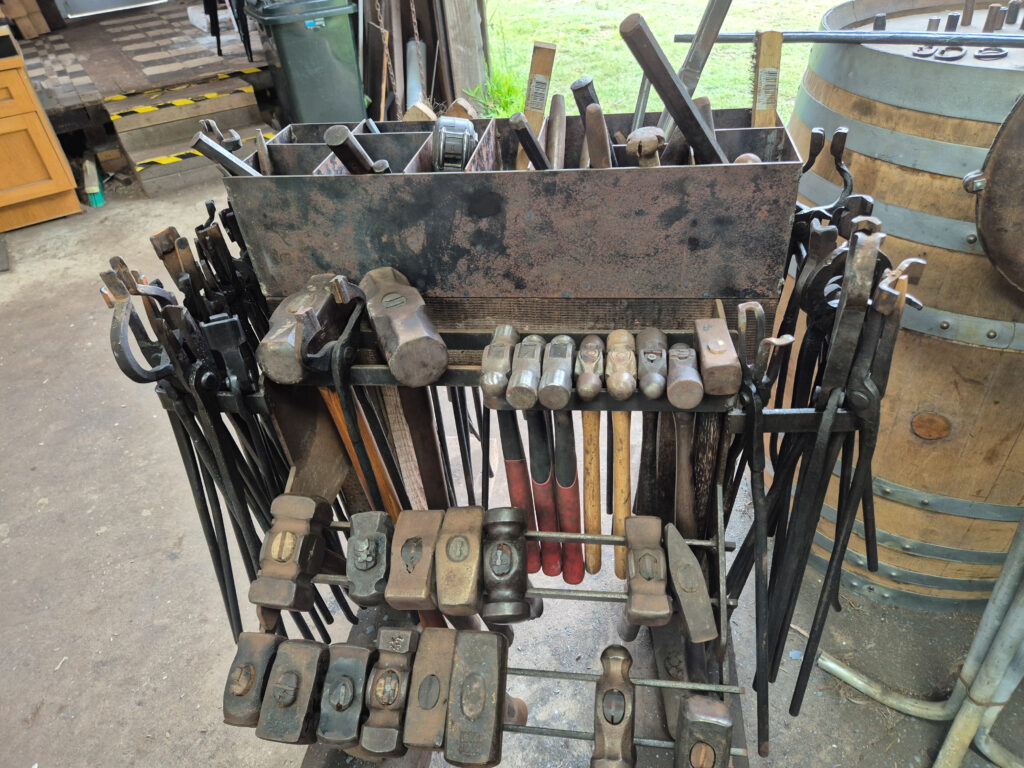


Bronek, my partner, and I are standing on either side of a 100-year-old anvil. I am inexpertly manipulating a strip of orange-hot metal with long handled box jaw tongs while he rhythmically bashes down on the metal with a sledgehammer. ‘The “hammer” doesn’t talk,’ instructs blacksmith Chris Stratford.
‘Their job is just to hammer.’ Before our eyes, the metal cools from orange to red to a dull grey.
It’s a waste of energy working with cooled (yet still extremely hot) metal, and I carefully carry it back to the forge for reheating. It’s my turn to be the hammer.
Grasping the 3.5 kg sledgehammer in two hands, I drop the head onto Bronek’s future knife. Bash. As I raise the hammer again, he uses his tongs to turn the metal 90 degrees. Concentrating hard, we get into a rhythm, I bash, he turns, bash, turn, bash, turn. It’s like a simple dance. The metal cools and we swap roles again.
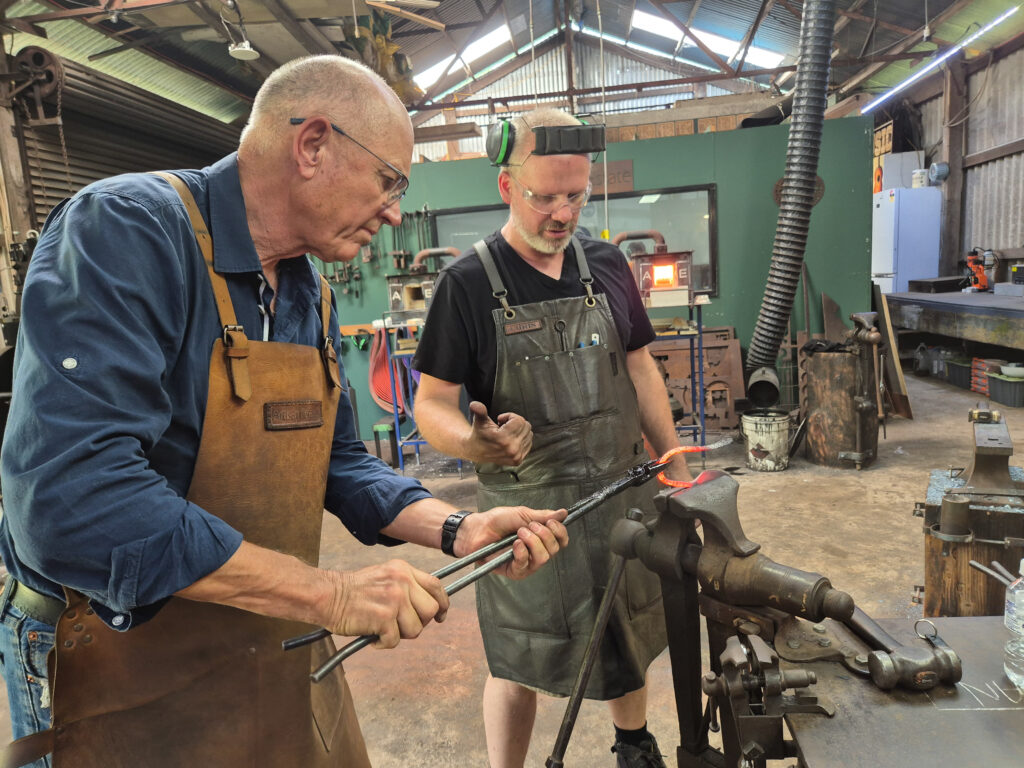
Our small group of four spent the first part of this blacksmithing workshop familiarising ourselves with the tools and techniques we’ll be using today. Wearing heavy duty leather aprons and protective glasses, we each made a simple key ring. At first, I found the box jaw tongs cumbersome and awkward, but soon they became an extension of my arm. I bevelled the edges of my keyring with the hammer and, with increasing confidence, punched a hole for the split ring.
Already, a small blister starts to form on my thumb. I’ve been holding the hammer too tightly. As I’ll be swinging it around 300 times today, I apply a preventative Band-Aid, try to relax my grip and to use the weight of the hammer head, not my muscle. Nevertheless, the work is physical.
Flakes of grey iron oxide gather around the base of the anvil. Sweat drips down my forehead. Chris reminds us to drink water. My increasingly dirty hands leave brown palm prints on my white enamelled water bottle. It’s safer and easier to manipulate the tools without gloves.
For my major project I choose a curly tailed knife or a ‘rat’s tail knife.’ Starting with a flat 15 cm length of metal, rather like a thick ruler, the task looks daunting. First, I pound a groove halfway along the metal to distinguish the blade section from the handle. Then, pounding and shaping the metal, I stretch the handle out to more than double its length. It’s a slow, laborious and quietly satisfying process.
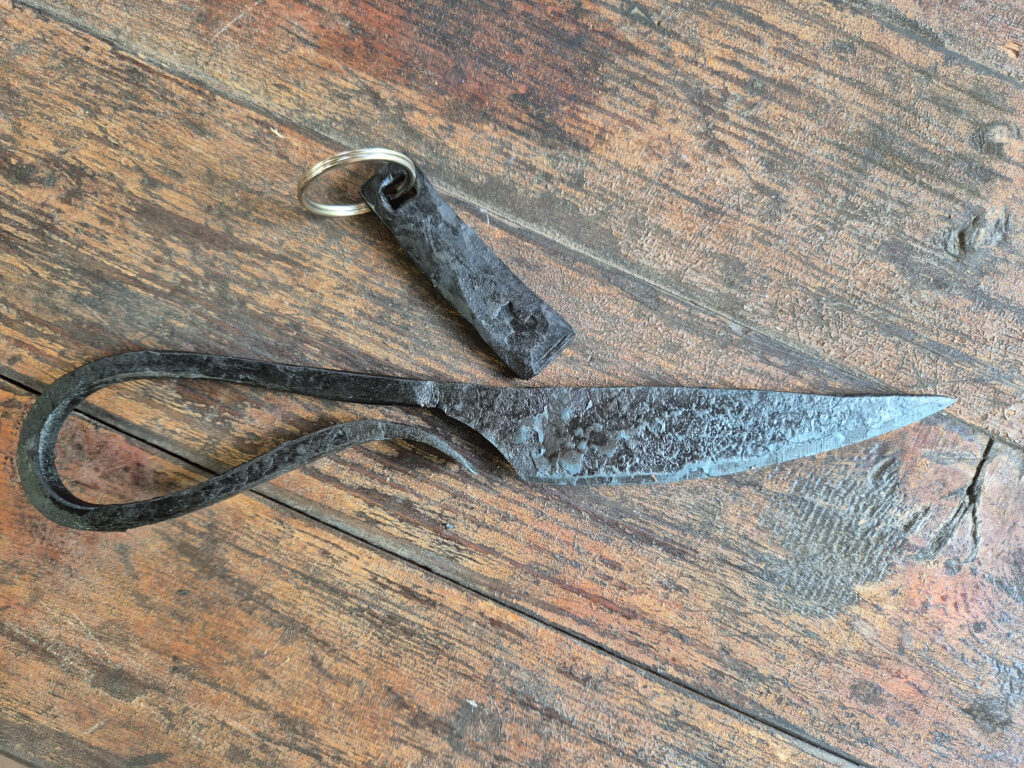
The blade comes next. As I shape, flatten and taper the blade, I get into a rhythm. Hammer, heat, quelch (cooling the tongs by plunging them into a barrel of water), hammer, heat, quelch.
Using the anvil’s horn, I knock the white-hot lengthened handle back on itself to form the rat’s tail. And there it is, my curly tailed knife. All that needs to be done is to sharpen the blade in the grinding room.
There’s a little crack halfway along my knife, and a nick in the blade, but I’m happy with my first forged knife. Blacksmithing isn’t complicated. It’s all about technique. And art.
Discover more about Artisan Estate.