

Some of the long-nosed fur seals around Broken Bay and Brisbane Water and up to Norah Head and beyond are such regular visitors that locals refer to them by name.
Around Brisbane Water there’s Sammy, who’s a bit of a character and likes leaping on to moored yachts out of harm’s way for a snooze on the cabin roof. (We have it on firsthand authority that he’s not as bad to clean up after as you may imagine.) Sammy’s even been known to jump aboard a moving ferry where, to the passengers’ delight, he stretched out and promptly fell asleep on the deck.
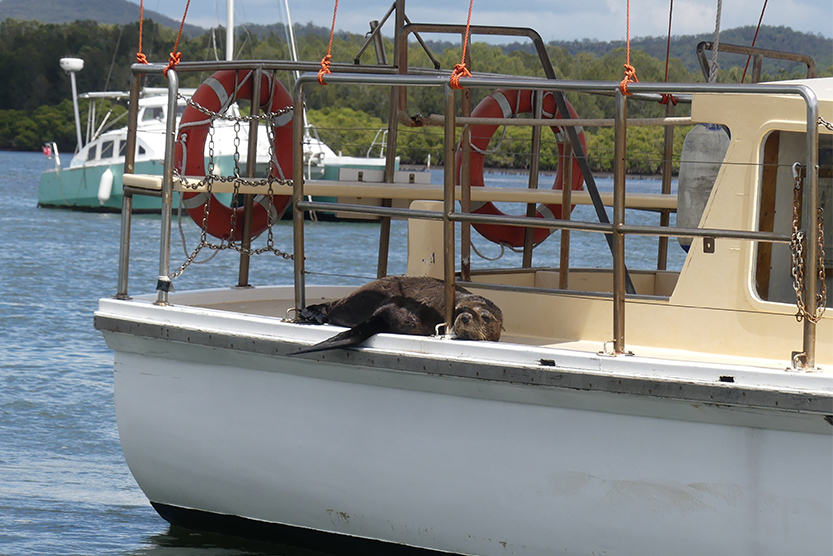
Sammy, the Brisbane Water seal, snoozing aboard the heritage ferry Codock II.
(Photo Jennifer Hartich)
Around Norah Head, Keeper thinks the beach is his own private domain. Around Terrigal, Rocky is a regular sight. And of course, there’s Wally, who likes to adventure in and out of Tuggerah Lake.
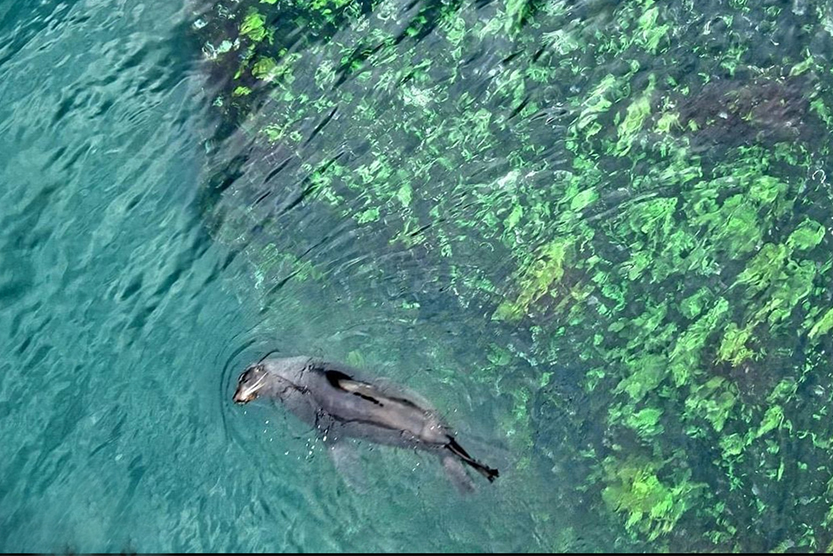
Rocky, the seal at Terrigal Haven, chilling by the seagrass. (Photo Chris Dick Photography)
The ‘bachelor’ colony at Barrenjoey
There’s also what is referred to as a ‘bachelor colony’ at the foot of Barrenjoey headland. The colony has been observed for around nine years and began with just four seals, growing to more than 20 now.
Courtship behaviours have certainly been observed for some time there between the big blubbery bull seals and the more petite females.
This is especially important because Australian fur seal populations are still recovering from the thriving fur trade of the 1800s. The males will mate with as many females as they can, whereas the females will mate with only one male.
Both the long-nosed and Australian fur seals are listed as vulnerable under the NSW Threatened Species Conservation Act 1995. Before their mass slaughterings, there were thought to be around half a million fur seals. Today, Australian fur seals are thought to number around 92,000.
The big news is that a newborn seal pup has been spotted sunbathing on the big rocks at Barrenjoey since the end of the pupping season, so any newborn is definitely welcome news.
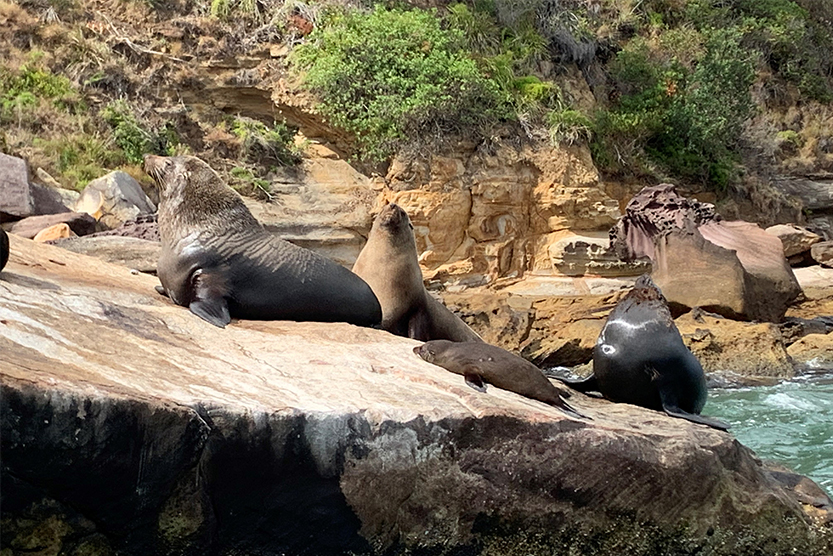
A seal pup rests on the rocks at Barrenjoey. (Photo Terrigal Ocean Tours)
Long-nosed fur seal, New Zealand fur seal or Australian fur seal?
We tend to mostly see the eared, long-nosed fur seals (previously known as New Zealand fur seals) because they are found in shallow inshore waters and around the margins of the continental shelf where they dive down to 380 metres to feed mostly on fish and cephalopods such as squid and octopus. Their cousins, the Australian fur seals, dive to a maximum depth of 200 metres where they mainly feed on squid, octopus, fish and lobsters.
The cousins are difficult to tell apart but long-nosed fur seals are slightly smaller and darker in colour.
Breeding colonies
Historically, seal breading sites in New South Wales included Port Stephens and the aptly named Seal Rocks, but today scientists tell us that our local seals migrate up from Montague Island which is the northern-most ‘major haul-out area’ along the NSW coast.
The local seals that continue to hang around here during winter are usually young bachelors or old bulls who can no longer compete with the up and coming young studs, or even bulls taking a rest from their demanding breeding regimes.
Threats to our seals
Like too many other marine animals, seals face a range of dangers today including the risk of becoming entangled in fishing gear and other marine debris. Collisions with vessels and outboard motors are also a serious concern, as are oil spills, accumulation of toxic compounds and commercial fishing which may lead to a reduction in the seals’ food supply.
‘In the future, rising sea levels and increased storm frequency induced by climate change will also threaten many breeding areas because seal pups are born close to sea level on rocky ledges and cliffs,’ says Dr Krista van der Linde, a New Zealand seal biologist from the University of Canterbury, who grew up on the Central Coast.
The seals’ main natural predators are sharks, and some local seals have even been seen with ‘cookie-cutter’ scars from the small sharks of the same name that take a circular, cookie-cutter sized chunk from their prey, leaving the seals able to survive the wound.
Seals spend their nights hunting and like to catch up on sleep during the day. But be warned, what seems like a sleepy yawn as you approach is really a threat display designed to show off a seal’s canine teeth.

Keeper, the seal at Norah Head,
poking his flippers above the water to help regulate his body temperature.
(Photo Matt Ghazawy)
Dr van der Linde advises people to always give seals their space and to understand that we should not be fearful, just respectful of these species. ‘Like all wild predators, if people approach and disturb or harass them, they will show warning signs and may attack.’
Ronny Ling from Marine Wildlife Rescue Central Coast agrees. ‘If you do come across a seal hauled out on the beach or rocks, keep a safe distance because they do bite,’ he warns. ‘Stay at least 40 metres away and never get between the seal and the water which is his escape route to safety. It goes without saying that you should keep children away, but dogs are a real danger to seals so please keep them under control and well back. And no matter how cute and sleepy they look, never try to touch seals or feed them.’
‘The fur seals which visit the Central Coast are part of a great story because their populations are recovering,’ continues Dr van der Linde.
‘Now we’ve got the next step to tackle as part of their conservation and management, that is actually working out how to live alongside them.’
If you see a seal, or any other marine wildlife you think may need help, please call Marine Wildlife Rescue Central Coast on 0478 439 965.
WORDS CATHARINE RETTER