
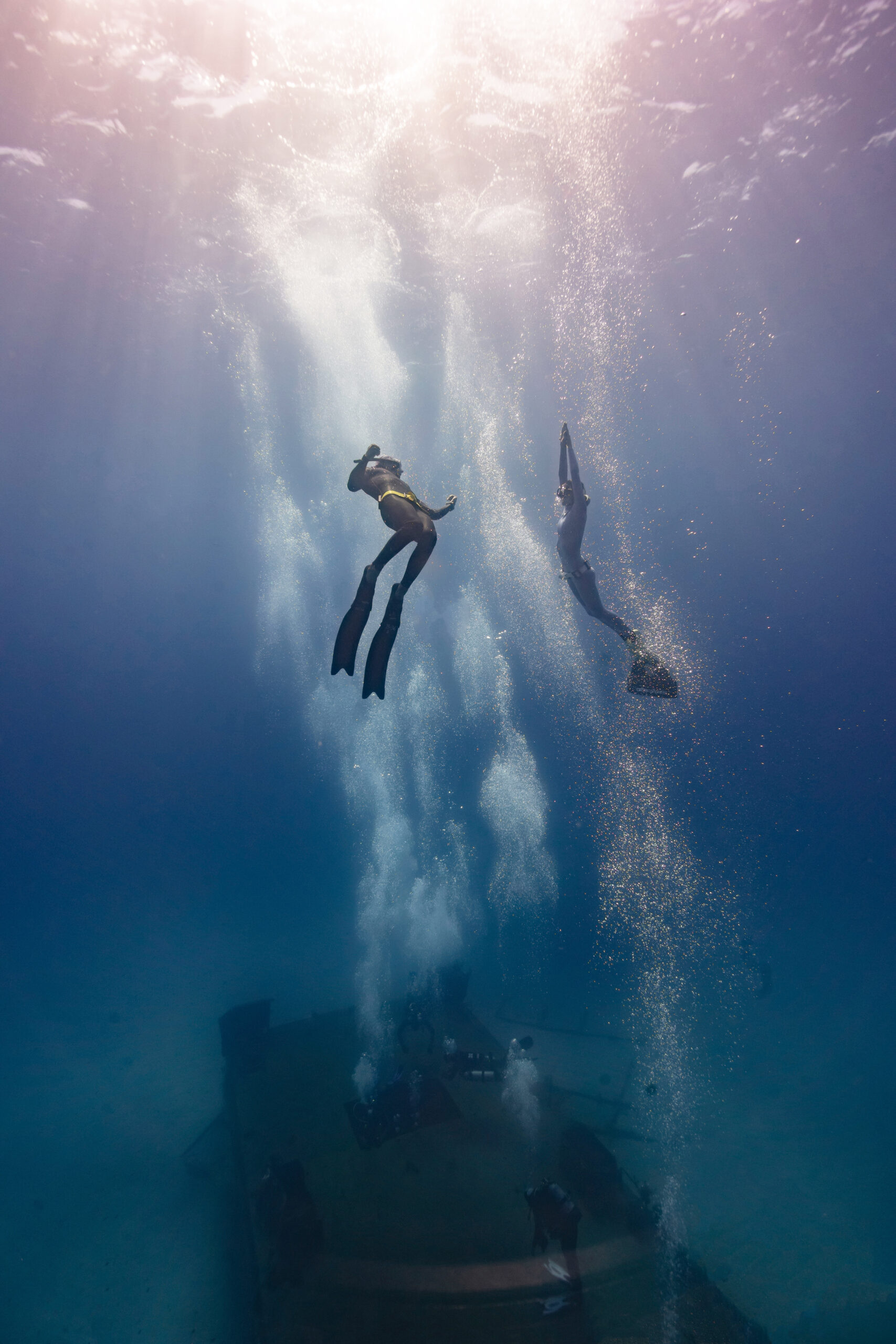
‘You duck beneath the surface where sunlight ribbons streak into the deep blue below. A taut rope cuts downward. It beckons you to follow. You kick deeper until, at around 20 metres, the pressure above you has increased to the point where you no longer have to kick hard to descend.
Eventually, you stop kicking, surrendering to your body freefalling. You feel weightless, at one with the ocean as you effortlessly glide into the depths. It feels like flying. Until, finally, you must turn around and kick strongly, back to the surface to breathe.’
Back to where humans rightly belong.
But how does the human body survive going to these depths without breathing? Surprisingly, it’s thanks to a physiological function we still share with seals, dolphins and whales; the mammalian dive reflex. Even when just your face is submerged in water, your heart rate slows, blood is redirected from your extremities towards vital organs, and your body starts to conserve oxygen.
At 10 metres below the surface, the surrounding pressure compresses your lungs to half their original size. By 20 metres, their capacity is reduced to a third. At 30 metres, it’s down to one-quarter and , all while the spleen cleverly contracts to release red blood cells to increase the blood stream’s oxygen-carrying capacity.
At 50 metres, the pressure is calculated at six atmospheres more than at sea level.
The summit of Mt Everest has around one third of atmospheric pressure. Long considered the ultimate human challenge, Everest’s summit has been reached by over 7,000 people. To put that into perspective, only 109 people have free dived to a depth of more than 100 metres underwater without oxygen.
Brie’s love for the ocean began in childhood, fundraising for Sea Shepherd at the age of eight and working on a whale-watching boat in high school. Later, she started a project to teach kids about marine conservation and volunteered for Australian Seabird and Sea Turtle Rescue throughout her HSC and early university years.
In 2016, she discovered free diving through her instructor Adam Stern, Australian record-holder and also a Central Coast local. ‘Once you start, it’s like a door opens to another world,’ Brie says.
In 2018, Brie competed in her first Australian national pool competition as the youngest female competitor and achieved personal bests in all disciplines.
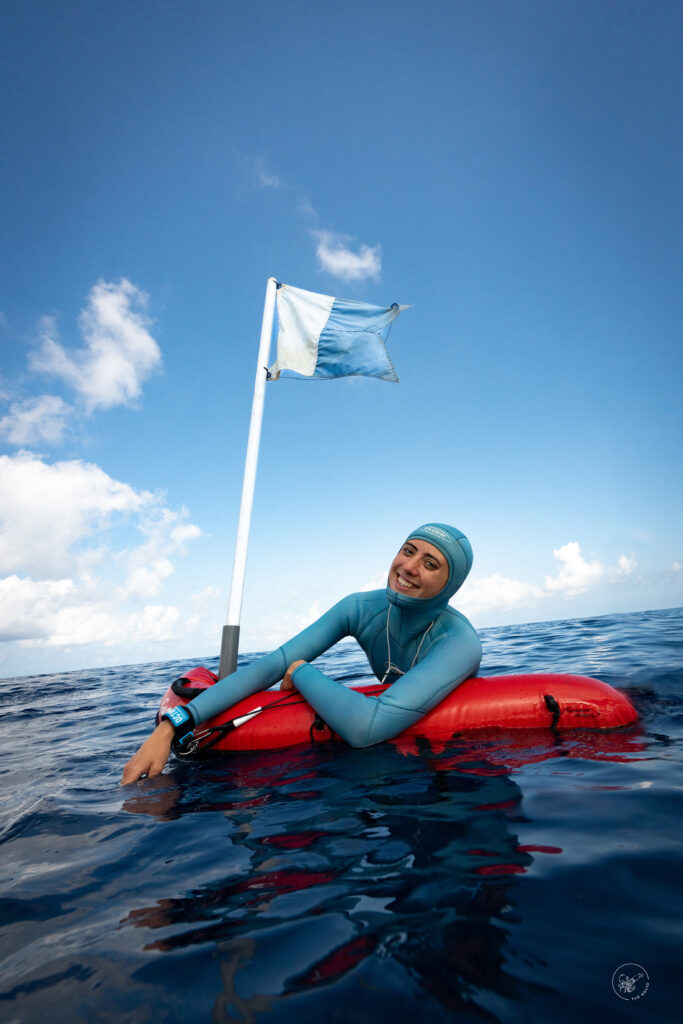
Image: @thesquid.global
Over the years, Brie has explored breathtaking (excuse the pun) locations like Indonesia’s Raja Ampat and Kauai in Hawaii, encountering playful sea lions, manta rays, ancient sea turtles and intelligent cuttlefish in their own territory. For Brie, freediving isn’t just a sport, it’s a way of life.
In 2024, Brie felt called to share her passion by teaching and coaching others, setting her on an incredible journey to Amed Bali, a free-dive hotspot. She then travelled to Gozo in Malta to live and teach with top free-diving athletes during the Maltese and Danish Championships. She became a Molchanovs-certified instructor under Danish Champion Jesper Stechmann and afterwards taught in Kalamata, Greece.
Now back home, she works in Sydney and the Central Coast, running beginner and advanced free-diving courses, safety diving for training sessions and breathing workshops for surf-school kids.
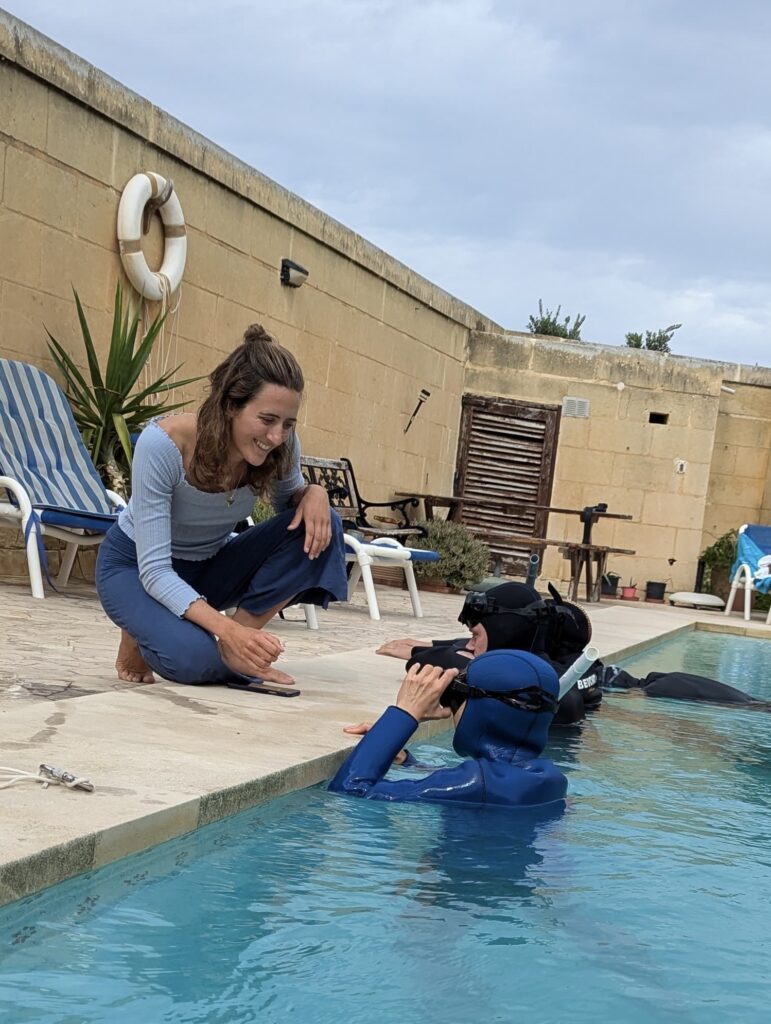
With a breath-hold of nearly five minutes and comfortably diving to 40 metres in depth, Brie’s skills may seem superhuman. But her expertise stems from years of dedication and mentorship.
‘Freediving has definitely changed me,’ she says. As in many people’s lives, there have been highs, as well as the lows of heartbreak, illness, injury, loss and grief. Brie felt at times she hit rock bottom but, ‘The ocean is always there for me when I need it most. You are really present when free diving. Connected to your body, breath, mind and the sea. Maybe that’s why it’s so addictive.’
While we land-bound creatures may be both terrified and mesmerised at the thought of free diving, Brie emphasises, ‘Free diving is safe as long as you know your limits and never dive alone. A course is the best way to learn the basics and join a supportive community, become certified, and importantly, be a safe buddy that others can trust.’
Follow @briefreediving on Instagram or contact brielle.revello@outlook.com or 0402 851 109 for course dates or training on the Central Coast.
Main image: @thesquid.global